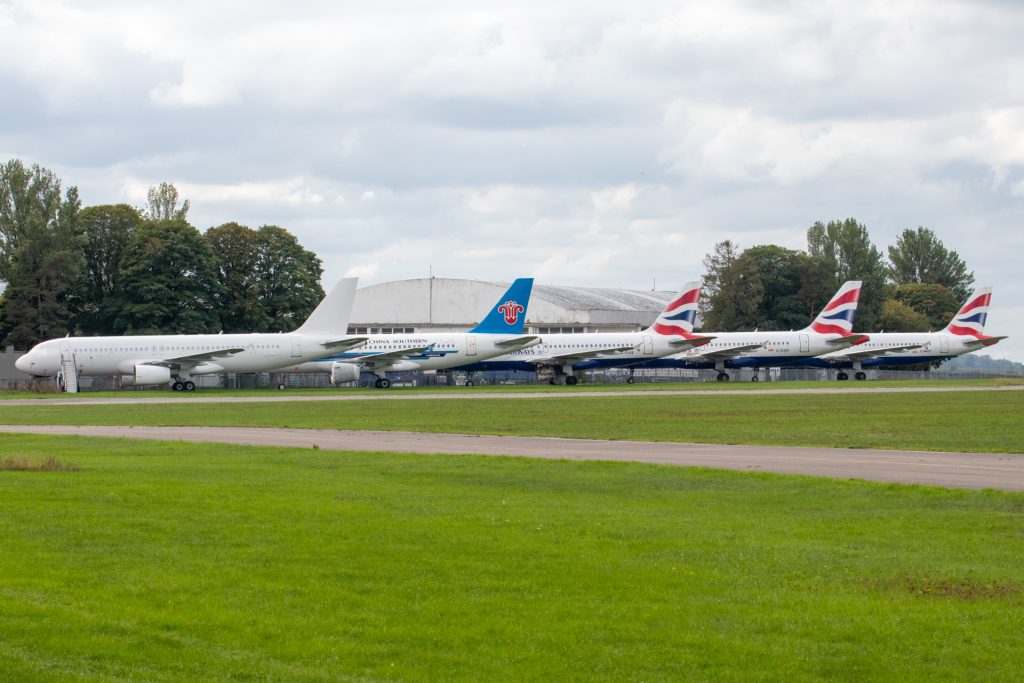
If you are searching for Cotswold Airport plane spotting, you have found one of the most interesting aviation locations in the UK.
Cotswold Airport, also known to many enthusiasts as Kemble Airfield, is very different from a conventional passenger airport. Rather than relying on a constant stream of scheduled airline traffic, Cotswold Airport offers aviation enthusiasts a constantly changing mixture of general aviation, business aircraft, maintenance activity, visiting aircraft and stored airliners.
For plane spotters and aviation photographers, that variety is exactly what makes Kemble so interesting.
One visit might produce photographs of a light aircraft or business jet. Another could reveal an airliner arriving for maintenance, a ferry flight, an unusual visitor or one of the many historic and stored aircraft associated with the airfield.
This guide explains what to expect from plane spotting at Cotswold Airport, where to watch from, what aircraft you may see and how to make the most of a spotting trip to Kemble.
Why is Cotswold Airport popular with plane spotters?
Cotswold Airport has a long aviation history. The airfield was formerly RAF Kemble, and today it is a busy private airport supporting general aviation, flying activity and a wide range of aviation-related businesses.
For spotters, however, one of its biggest attractions is the presence of stored and retired airliners.
Aircraft can arrive at Kemble for storage, maintenance, recycling or other purposes, meaning the aircraft population can change considerably over time. The airport has consequently become a well-known destination for enthusiasts interested in airliners that are no longer flying regular passenger services.
You can also encounter aircraft ranging from small general aviation types to large Boeing and Airbus airliners.
That combination makes Cotswold Airport spotting particularly appealing to enthusiasts who enjoy aircraft variety rather than simply counting scheduled movements.
Cotswold Airport spotting: what can you see?
There is no guaranteed list of aircraft at Cotswold Airport because the airport’s traffic and stored aircraft population change.
That is part of the attraction.
Stored and retired airliners
The airliner storage and recycling activity is one of the main reasons aviation enthusiasts travel to Kemble.
Over the years, the airfield has hosted aircraft including:
- Boeing 737s
- Boeing 747s
- Airbus A319s
- Airbus A320s
- Airbus A340s
- Boeing 727s
- Business jets
- Regional aircraft
- Various unusual and rare airframes
Aircraft may be present for different lengths of time, so a storage list that was accurate on one visit can quickly become outdated.
For serious spotters, this means repeat visits can be worthwhile because the aircraft scene at Cotswold Airport is constantly evolving.
General aviation
Cotswold Airport is also an active general aviation airfield rather than simply an aircraft storage facility.
Light aircraft, training aircraft and other GA movements provide plenty of interest between larger arrivals and departures.
The airport is home to flying organisations and aviation businesses, and the control-tower area provides an excellent place to appreciate the wider activity taking place around the airfield.
Business jets and visiting aircraft
Business aviation adds another layer of unpredictability.
Visitors can range from smaller private aircraft to larger executive jets, and unusual movements can make an otherwise quiet spotting session particularly memorable.
This is one of the reasons experienced spotters often recommend keeping an eye on Cotswold Airport even when there are no obvious major movements planned.
Where are the best Cotswold Airport spotting locations?
The best Cotswold Airport spotting location depends on what you want to see.
The airport is private property, so it is particularly important to distinguish between places where aircraft can be viewed legitimately and areas where access is restricted.
Always follow current airport instructions, public access arrangements, signs and local restrictions.
1. The AV8 Restaurant and Control Tower area
The AV8 Restaurant and Control Tower area is one of the most convenient options for enthusiasts visiting Cotswold Airport.
It provides views across parts of the airfield and aircraft parking areas, while the restaurant offers food, drinks and somewhere to take a break during a longer spotting session.
The official airport website confirms that AV8 operates alongside the airport and that the site has views over the airport.
For a first visit, this is a particularly useful place to orientate yourself with the airfield.
You can watch aircraft movements, look across the parking areas and get a feel for where activity is taking place before deciding whether to move elsewhere.
2. The A429
The A429 is another location traditionally associated with Kemble plane spotting.
Published spotting information identifies a lay-by alongside the road as a useful place to observe aircraft and view aircraft around the eastern side of the airfield.
The important point is to use only legitimate places to stop and observe.
Do not park dangerously, obstruct the road, enter restricted areas or cross barriers for a better photograph.
A good spotting location is never worth creating a safety or security problem.
3. Other perimeter viewpoints
Depending on the current airport arrangements, there may be other places around the airfield from which aircraft can be seen.
However, access conditions can change.
Some older spotting guides describe areas that may no longer have the same access arrangements, so information found online should always be treated as historical unless it has been recently confirmed.
For that reason, check the current airport information before travelling rather than relying solely on an old spotting guide.
What is the best time for plane spotting at Cotswold Airport?
There is no single guaranteed “best time” for Cotswold Airport plane spotting.
Unlike a major airline airport, Kemble does not have a continuous timetable of passenger departures and arrivals for spotters to follow.
The most productive visit depends on the day’s flying activity, maintenance movements, visiting aircraft and changes to the stored fleet.
For that reason, flexibility is useful.
If you are travelling a long distance, check available movement information and current airport updates before setting off.
It is also worth allowing several hours rather than expecting to arrive for 30 minutes and see a constant stream of aircraft.
Cotswold Airport is particularly suited to enthusiasts who enjoy the anticipation of an unexpected movement.
Cotswold Airport photography tips
Kemble can be an excellent location for aviation photography, but the best camera setup depends heavily on where you are standing and what aircraft you are photographing.
Use a flexible zoom lens
A lens covering a useful range of focal lengths is generally more practical than carrying only one fixed lens.
A shorter focal length is useful for aircraft nearby or larger subjects, while a longer lens can help when aircraft are further away.
Watch the light
As with any aviation photography location, the position of the sun can make a huge difference.
Morning and afternoon light can produce very different results, particularly when photographing aircraft parked around the airfield.
Avoid shooting directly towards a low sun where possible.
Watch for heat haze
Heat haze can be a major problem when photographing aircraft at a distance.
This is particularly relevant when shooting stored aircraft or distant movements across the airfield.
A long lens can magnify atmospheric distortion as well as the aircraft itself.
If the air is hot, photographs taken with a shorter focal length and closer viewpoint may look considerably sharper.
Keep your shutter speed high for moving aircraft
For aircraft in flight, a sufficiently fast shutter speed helps freeze movement.
For propeller aircraft, however, you may deliberately want a slower shutter speed to retain propeller blur.
There is no single perfect aviation photography setting, so experiment with your camera and adjust for the conditions.
Don’t forget the stored aircraft
One of the biggest mistakes a first-time visitor can make is concentrating exclusively on runway movements.
The stored aircraft are an important part of the Cotswold Airport experience.
Aircraft parked around the airfield can provide opportunities for:
- Registration photography
- Fleet identification
- Aircraft type identification
- Airline history research
- Serial-number research
- Before-and-after photography
- Recording aircraft movements into and out of storage
The aircraft population can change, so keeping your own notes is worthwhile.
Record the registration, aircraft type, operator or former operator, date and location where possible.
For enthusiasts who enjoy detailed aircraft records, Kemble can become an ongoing project rather than a one-day spotting trip.
A special aircraft at Cotswold Airport: Boeing 747 G-CIVB
One of the most recognisable aircraft associated with Cotswold Airport is the former British Airways Boeing 747-400 G-CIVB, known as “Negus”.
The aircraft arrived at Cotswold Airport in October 2020 after the retirement of the British Airways 747 fleet and was preserved rather than being scrapped. It remains an important part of the airport’s aviation heritage.
For aviation photographers and enthusiasts, the aircraft provides a particularly interesting photographic subject and another reason to combine aircraft spotting with a visit to the wider airport site.
Cotswold Airport opening times for spotters
Current information from Cotswold Airport states that the airport is open to the public:
Tuesday to Sunday: 09:00–17:00
The airport is currently closed to the general public on Mondays. The official website also notes that out-of-hours arrivals and departures can be arranged directly with airport operations.
Opening arrangements can change, particularly around events or operational requirements, so check the official Cotswold Airport information before making a dedicated spotting trip.
How to get to Cotswold Airport
Cotswold Airport is located near Kemble in Gloucestershire, around seven miles southwest of Cirencester.
The airport’s official address is:
Cotswold Airport
Cirencester
Gloucestershire
GL7 6BA
The airport has two entrances because the main east-west runway divides the site. The official airport website recommends using postcode GL7 6BA for navigation.
If you are travelling specifically for plane spotting, allow extra time for the journey and make sure you understand where you are permitted to park and observe aircraft.
Cotswold Airport spotting etiquette
Good spotting etiquette matters at any airfield, but it is especially important at a privately operated airport.
Stay in permitted areas
Never enter restricted airport areas simply to get a closer photograph.
Aircraft can be fascinating, but security and safety take priority.
Don’t climb fences
If you cannot get the photograph from a legitimate viewing position, accept that the aircraft may not be photographable from that location.
Don’t obstruct airport operations
Do not block access roads, gates, entrances, emergency routes or other vehicles.
Respect airport staff
Cotswold Airport is a working aviation environment, not simply a viewing attraction.
Follow instructions from airport staff and move if you are asked to do so.
Don’t trespass
This is particularly important around aircraft storage and maintenance areas.
Some of the most interesting aircraft may be close to public roads or accessible-looking areas, but that does not mean the land is publicly accessible.
Share information responsibly
Spotters often share movement information through online communities.
When sharing information, avoid publishing anything that could compromise airport security or encourage other enthusiasts to enter prohibited areas.
Responsible spotting helps maintain good relationships between aviation enthusiasts and the airport.
Is Cotswold Airport good for plane spotting?
Cotswold Airport offers a very different spotting experience from airports such as Heathrow, Manchester or Birmingham.
You are unlikely to see a constant procession of scheduled passenger aircraft.
Instead, the appeal is the variety and unpredictability.
You could spend part of your visit photographing general aviation, then see a business jet, an unusual visiting aircraft or a large airliner associated with storage or maintenance.
For enthusiasts interested in aircraft history, the stored fleet adds another dimension.
That means Cotswold Airport is particularly interesting for spotters who enjoy identifying unusual aircraft, tracking registrations and photographing aircraft that may not be seen anywhere else.
What should you take plane spotting at Kemble?
For a dedicated spotting trip, consider taking:
- Camera and spare batteries
- Telephoto or versatile zoom lens
- Binoculars
- Aircraft identification guide or app
- Notebook or spotting app
- Phone for checking movement information
- Weatherproof clothing
- Sun protection
- Food and water
- Ear protection where appropriate
- A small step or spotting ladder only where its use is permitted
A charged phone is particularly useful because aircraft movements and weather conditions can change during the day.
Cotswold Airport plane spotting in different weather
Don’t automatically cancel a spotting trip because the weather is not perfect.
Overcast conditions can be excellent for aircraft photography because harsh shadows are reduced.
Rain can produce interesting reflections on aircraft surfaces, while clear weather can provide excellent long-distance views.
Wind direction is also worth monitoring because it can influence runway usage.
Cotswold Airport operates runway 08/26, and the airport has established approach procedures for both runway directions.
The airport also publishes noise-abatement procedures for aircraft operating around the surrounding villages, so actual flight paths can vary according to operational requirements.
Keep your own Cotswold Airport aircraft log
If you regularly visit Kemble, keeping a personal Cotswold Airport aircraft log can turn casual plane spotting into a rewarding long-term hobby.
Record:
| Detail | What to record |
|---|---|
| Date | Date of sighting |
| Registration | Aircraft registration |
| Aircraft type | Boeing, Airbus, Cessna etc. |
| Operator | Current or former operator |
| Movement | Arrival, departure or parked |
| Location | Where you saw it |
| Photograph | File/photo reference |
| Notes | Any unusual details |
This can be particularly useful when aircraft move between storage areas, maintenance facilities and other locations.
Cotswold Airport plane spotting FAQs
Is Cotswold Airport open to plane spotters?
Cotswold Airport is open to the public Tuesday to Sunday, currently 09:00–17:00. However, public access does not mean every part of the airfield is accessible. Always remain within permitted areas and follow airport instructions.
Can you photograph aircraft at Cotswold Airport?
Aircraft can be photographed from legitimate public or permitted viewing locations. Photography should never involve trespassing, entering restricted areas or interfering with airport operations.
What aircraft can you see at Cotswold Airport?
The aircraft scene includes general aviation, business aircraft, visiting aircraft and stored or retired airliners. The exact aircraft present changes regularly.
Is Cotswold Airport the same as Kemble?
Yes. Cotswold Airport is the current name of the airfield commonly referred to by enthusiasts as Kemble or Kemble Airfield. Its airport identifiers include GBA and EGBP.
Does Cotswold Airport have scheduled passenger flights?
Cotswold Airport is primarily a private/general aviation airport rather than a conventional scheduled passenger airport. Spotters therefore visit for general aviation, business aviation, visiting aircraft and its storage and maintenance activity.
Where is Cotswold Airport?
Cotswold Airport is near Kemble and Cirencester in Gloucestershire. The airport’s official postcode is GL7 6BA.
What is the best Cotswold Airport spotting location?
The answer depends on what you want to photograph. The AV8/control-tower area provides convenient views over parts of the airfield, while the A429 has traditionally been used by spotters to observe activity and aircraft around the eastern side. Always check current access arrangements before visiting.
Plan your next Cotswold Airport spotting trip
For aviation enthusiasts, Cotswold Airport plane spotting is about much more than watching aircraft take off and land.
The combination of general aviation, business jets, visiting aircraft, maintenance activity, stored airliners and historic aircraft makes Kemble one of the UK’s more unusual aviation destinations.
The key is to arrive prepared, check the latest information, bring the right camera equipment and, most importantly, respect the airport and its operating restrictions.
You may not know exactly what will appear in front of your camera when you arrive at Cotswold Airport — and for many plane spotters, that’s precisely the appeal.
Before travelling, check the latest information directly with Cotswold Airport, particularly regarding opening hours, access and any temporary restrictions.